
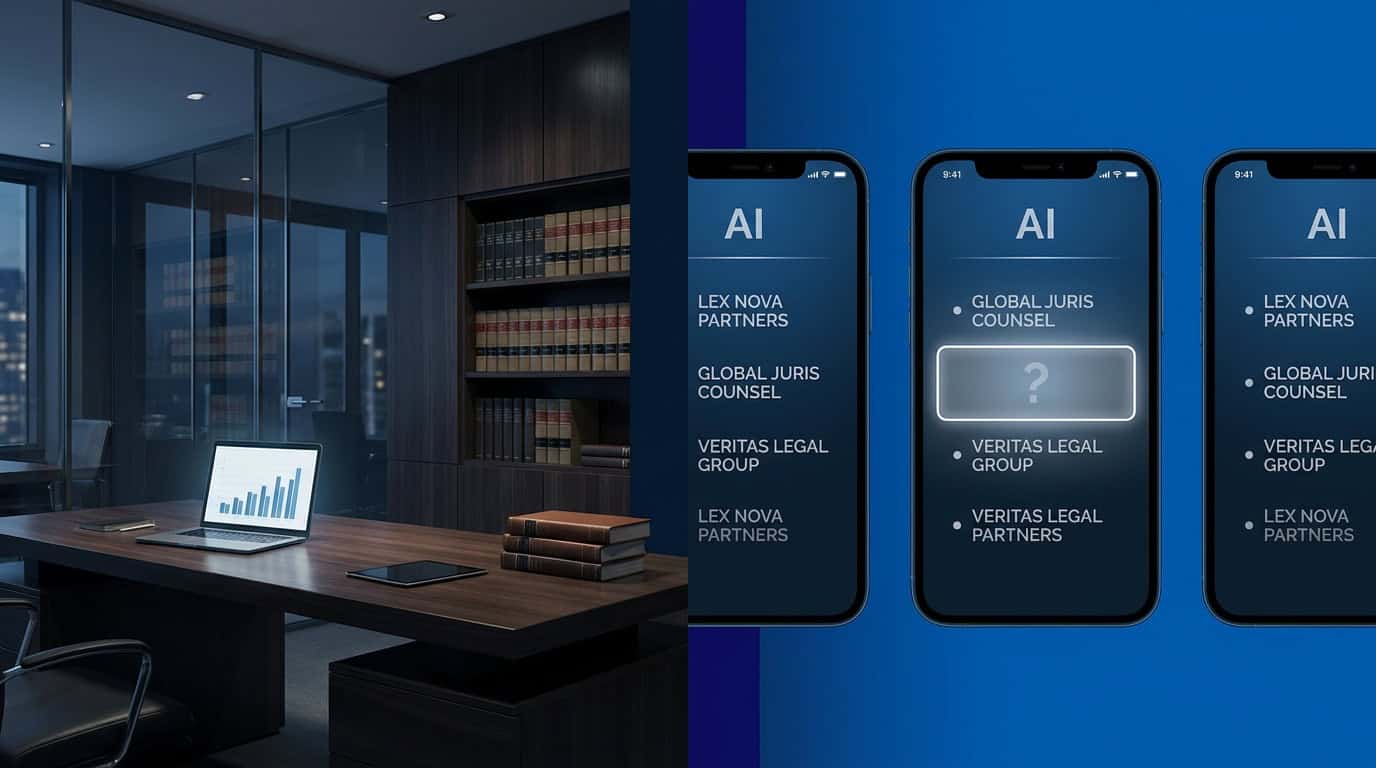
By Vinay Koshy, Founder, CitedCounsel [AI-ASSISTED]
Last Updated: May 18, 2026
Most employment law firms in AI search are invisible for a structural reason: their content is built for Google ranking, not for the entity clarity and direct-answer architecture that ChatGPT, Perplexity, and Google AI Overviews require before citing a firm. The result is measurable: a firm invisible across 20 high-value AI search queries in a major US market forfeits an estimated $1.2M–$2.4M in annual addressable case value to the one or two competitors appearing in those answers.
AI referral traffic to professional service websites grew 527% between January and May 2025 (Ahrefs, 2025). CitedCounsel has audited employment law citation patterns across New York City, Chicago, Los Angeles, Houston, and Sydney. The pattern repeats across markets: one or two firms capture 70–80% of AI citations for the highest-value queries in their practice area, while the remaining firms receive none, regardless of size, reputation, or advertising spend. For employment law firms with matters valued at $25,000–$500,000, that is a revenue leak with a measurable dollar value.
Employment law firms in AI search are invisible because their content is structured for Google ranking, not AI citation.
This article explains what AI citation invisibility is, why it occurs differently across platforms, what it costs, and the three-step fix.
Table of Contents
Which AI Platforms Matter Most for Employment Law Firms in AI Search?
Three AI systems independently decide which employment law firms to cite: Perplexity, ChatGPT, and Google AI Overviews. A firm can rank #1 on Google and still be absent from Perplexity and ChatGPT entirely.
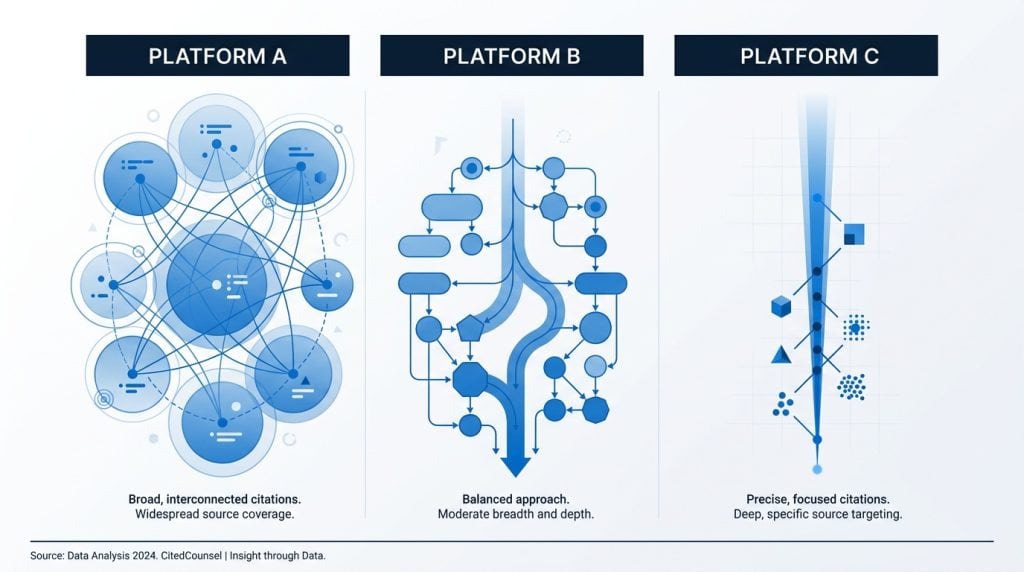
These platforms operate on different data sources and citation logic. Understanding the distinction matters for where to invest:
| Platform | How it decides which firms to cite | Overlap with Google rankings | Primary employment law buyer |
|---|---|---|---|
| Perplexity | Live web search + synthesis; draws from legal directories, bar listings, and well-structured content pages | ~75% overlap with Google page-one results | GCs and HR directors doing preliminary research |
| ChatGPT (GPT-4o) | Training data + live browsing; weights the “4 R’s”: Ratings, Reviews, Recognitions, Roots (directory profiles) | Less than 25% overlap with Google | Founders and executives bypassing Google entirely |
| Google AI Overviews | Same crawler and index as Google organic; strong SEO = strong AI Overview overlap | ~77% overlap with top-30 organic results | High volume; appears above organic listings for most legal queries |
The critical number: only 11% of domains get cited by both ChatGPT and Perplexity (Martindale-Avvo, 2026). Being strong in one does not carry to the other. Each platform builds its own picture of who the authoritative sources are.
A firm can rank #1 in Google and still have a near-zero citation rate in Perplexity. They are separate systems with separate citation requirements.
The buyers using these platforms to research employment counsel are among the most AI-active professionals in the workforce. A 2024 Wolters Kluwer survey found that 72% of corporate legal departments had already integrated AI tools into their workflows. General counsel and HR directors research outside employment counsel the same way they research any other professional service: by asking AI tools who the best options are in their market.
Why Are Most Employment Law Firms Invisible in AI Search?
Most employment law firms are invisible in AI search because they are missing four specific structural signals: entity clarity, answer architecture, verifiable legal citations, and FAQ schema markup. All four must be present for consistent multi-platform citation. If any one is missing, the firm remains invisible.
Entity clarity is the foundation. An AI engine needs to identify a law firm unambiguously: its name, practice areas, geographic market, and named attorneys, across every authoritative source the model was trained on or actively crawls. An April 2026 report by 5WPR found that seven directories own the AI citation layer for virtually every legal query tested: Chambers, Legal 500, Super Lawyers, Best Lawyers, Martindale-Hubbell, Avvo, and Justia. When ChatGPT, Perplexity, or Google AI Overviews names a law firm, the citation comes from one of these seven sources. A firm with incomplete or inconsistent profiles across these directories is structurally invisible, regardless of Google rankings, review volume, or advertising spend.
Most law firm websites describe the firm in general terms (“full-service employment law representation”), use inconsistent practice-area language across pages, and have incomplete or outdated profiles in these directories. From an AI engine’s perspective, ambiguity makes a firm a risky citation. If the model is not confident about the firm’s activities and where it operates, it will not name the firm in its answer.
Answer architecture is the single biggest differentiator between cited firms and invisible ones. AI engines extract citations at the sentence level. They look for content that directly and completely answers a specific question in one sentence or a short paragraph. CitedCounsel calls these citable units.
A page that opens “There are several factors that determine whether wrongful termination applies to your situation, and these vary depending on the state in which you were employed…” is a narrative explanation. It will be scanned and skipped. A page that opens “Wrongful termination occurs when an employer dismisses an employee for an illegal reason, including discrimination, retaliation for whistleblowing, or breach of an employment contract” is exactly what gets cited.
AI engines cite content that opens with a direct answer. Firms using narrative explanations are consistently skipped.
Verifiable legal citations are the third signal most firms miss. AI engines trained on legal content weigh sources that link to statutes, case law, and bar association guidance (the same sources the models were trained on). A page discussing wrongful termination that cites Title VII of the Civil Rights Act and links to EEOC guidance is considered more authoritative than one that discusses the same topic without those references. Most law firm content reads like a marketing brochure. It makes claims without citing the legal authority behind them, which weakens its signal to AI citation engines.
FAQ schema markup is the technical implementation of answer architecture. It tells AI engines (and Google) that specific content is structured as question-and-answer pairs, making each Q&A directly extractable as a citation candidate. Most law firm websites have no FAQ schema. Of those that do, most apply it to generic intake questions (“How much does it cost to hire an employment lawyer?”) rather than the substantive legal questions their ideal clients are typing into ChatGPT.
What Does AI Search Invisibility Cost an Employment Law Firm?
An employment law firm invisible across 20 high-value queries in a major US market forfeits an estimated $1.2M–$2.4M in annual addressable case value to competitors. That figure is based on published industry-average matter values and is not representative of any specific firm’s actual revenue situation.
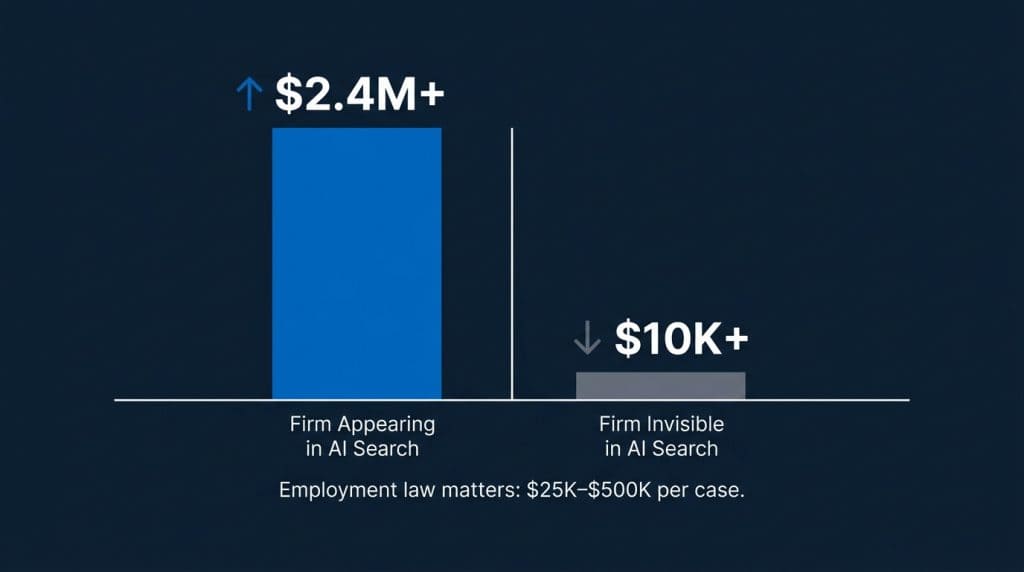
The methodology CitedCounsel uses in every citation audit assigns each query a case value based on practice area and matter type. For employment law matters, wrongful termination cases average $85,000–$180,000 per case at plaintiff-side firms; discrimination and harassment cases range from $150,000–$450,000; wage-and-hour collective actions start at $250,000. Citation rate determines the estimated share captured versus forfeited.
In CitedCounsel’s April 2026 audit of 10 NYC employment law firms, testing 20 high-value queries across ChatGPT, Perplexity, and Google AI Overviews, Vinay Koshy found a consistent pattern. One firm appeared in 16 of 20 queries. It has 22 attorneys. It is not the largest employment law firm in New York City, not the highest-rated, not the most decorated. What it has is three articles, precisely structured for AI citation (direct answers, FAQ schema, named attorney attribution), and complete, consistent entity profiles across every major legal directory.
Eight other firms, several of which were larger, older, and had bigger marketing budgets, appeared in zero queries. One spends more on Google Ads per month than the leading firm spends on its entire marketing budget.
Structural quality beats firm size in AI citations. A 22-attorney firm with properly structured content can outperform much larger competitors.
For mid-size employment law firms, that is an opportunity, but only for those who move before their competitors do. AI citation authority compounds: the more content is structured and indexed, the more citation opportunities each new piece creates.
What Does It Take for an Employment Law Firm to Appear in an AI Search?
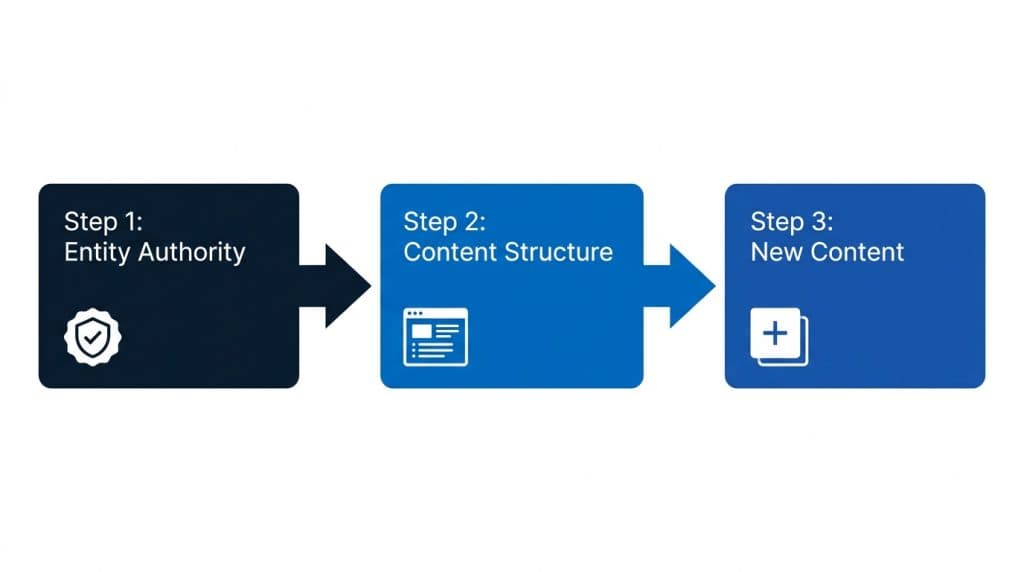
CitedCounsel’s LLMSEO methodology requires three steps in sequence to build AI citation for an employment law firm: entity authority establishment, content restructuring, and targeted new content. Skipping any one produces partial results.
Step 1: Build entity authority across the 7 directories that own AI citations
Before publishing anything new, establish the firm’s unambiguous presence across the seven authoritative sources AI models treat as ground truth: Chambers (for firms that qualify), Legal 500, Super Lawyers, Best Lawyers, Martindale-Hubbell, Avvo, and Justia. Each requires a complete profile: firm name, named attorneys with credentials, practice areas in exact terminology, and consistent address and contact data. This takes 4–6 hours, done properly. It is the most important single step in the process and produces visible improvement in AI citation rates within 2–4 weeks of completion.
Step 2: Restructure existing content for direct-answer architecture
Most employment law firm websites have sufficient content volume. What they lack is a direct-answer structure. Audit each practice area page against four questions: Does it open with a direct, complete answer to the page’s primary query? Does it include a FAQ section of 5–8 questions phrased as a client would type them into ChatGPT? Is there a named attorney attributed as the author? Does the page include FAQ schema markup? Restructuring five existing high-traffic pages typically produces faster AI citation results than publishing five new articles.
Step 3: Target specific query gaps with new content
Once entity authority is in place and existing content is restructured, the remaining citation gap is typically explained by a small number of high-value queries for which the firm has no relevant content. A single well-structured article (1,800–2,500 words, direct-answer structure, named attorney attribution, FAQ schema targeting 5–8 verbatim client questions) is usually sufficient to generate Perplexity and Google AI Overview citations within 30–60 days of publication.
Three steps determine AI citations for employment law firms: entity authority, direct-answer content restructuring, and targeted new content. Skip any one, and the firm stays invisible.
The compliance dimension is specific to law firms: every piece of content must be reviewed against applicable bar advertising rules before publication. ABA Formal Opinion 512 (2023) confirmed that attorneys are personally responsible for AI-assisted and AI-generated marketing content under the same professional responsibility standards governing all advertising. Content structured for AI citation, with direct answers, named attorney attribution, and specific legal claims, falls squarely within the territory regulated by state bar advertising rules. Every article CitedCounsel produces includes a compliance review as a standard step.
How Long Before an Employment Law Firm Appears in AI Search?
An employment law firm starting from near-zero AI citation should expect meaningful improvement within 60 days and a defensible citation position, appearing in the majority of high-value queries in its market, within 6 months.
The timeline by work type: entity authority work produces AI citation improvements within 2–4 weeks of completion. Content restructuring produces Perplexity citations within 30–45 days; Google AI Overviews typically require 45–60 days. New content targeting specific query gaps follows the same timeline: 30–60 days for first citations, with citation rate increasing over the following 60–90 days as the content accumulates authority signals across directories and linking sources.
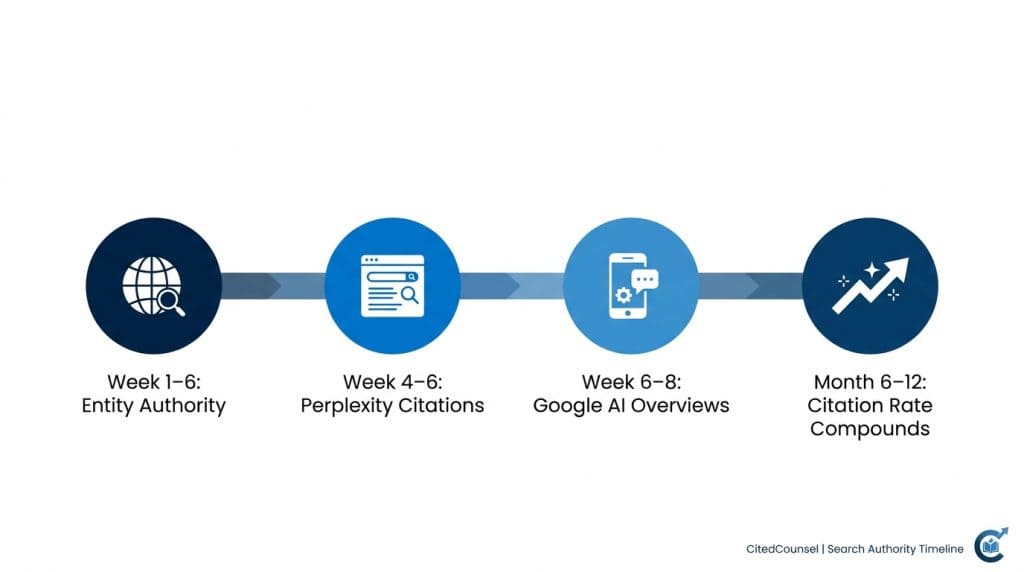
Employment law firms starting from near-zero AI citation should expect meaningful improvement within 60 days and a defensible citation position within 6 months.
A firm that starts now and executes this framework consistently will have a significantly stronger AI citation position than a firm that waits six months to begin. AI citation authority compounds: the more content is structured and indexed, the more citation opportunities each new piece creates.
For additional law firm AI citation analysis and case studies, visit the CitedCounsel Insights library.
Frequently Asked Questions
Q: Is AI search actually driving real cases to law firms right now?
A: Yes. Firms that appear consistently in ChatGPT, Perplexity, and Google AI Overviews are receiving inbound inquiries from clients who have bypassed Google entirely. AI referral traffic to professional service websites grew 527% between January and May 2025 (Ahrefs, 2025). ABA research shows 96% of people seeking legal services begin with an online search; the AI layer is now the first page of that search for an increasing share of buyers.
Q: Does AI citation optimization replace traditional SEO?
A: No. It is a separate and complementary discipline. A firm can rank number one on Google for “wrongful termination attorney NYC” and still have a near-zero Perplexity citation rate. Traditional SEO optimizes for Google ranking signals; AI citation optimization addresses entity clarity, direct-answer architecture, and FAQ schema. These have different requirements and different techniques. Less than 25% of ChatGPT’s law firm recommendations overlap with Google’s page-one results (Martindale-Avvo, 2026), making this a genuinely separate visibility channel.
Q: Do smaller employment law firms have a realistic chance against large firms in AI search?
A: More than in traditional SEO. Entity clarity and content structure are the primary AI citation signals, not domain authority, advertising budget, or firm size. The pattern CitedCounsel consistently observes is that a 12–25-attorney firm with properly structured content outperforms larger, better-funded competitors in AI citation. Structural quality beats scale in AI citations, unlike in traditional search. This is one of the rare dynamics in legal marketing that favors the nimble firm over the large one.
Q: What practice areas within employment law generate the most AI search volume?
A: Wrongful termination, discrimination, and harassment claims, and employment contract disputes generate the highest AI search volume and the highest case values per query. These are the matter types where general counsel and HR directors (the most AI-search-active buyer segment) seek outside employment counsel. Wage and hour disputes and FMLA/leave matters generate significant volume on the plaintiff side for individual employees.
Q: How do I find out where my firm currently stands in AI search?
A: An AI citation audit tests your firm across 20 high-value queries in your practice area and city across ChatGPT, Perplexity, and Google AI Overviews. It gives you your current citation rate, identifies which competitors are capturing each gap, assigns a dollar value to each uncaptured query, and produces a prioritized action plan. CitedCounsel’s $197 AI Citation Report delivers this analysis, typically within 15 minutes of submission.
Q: Can a law firm do this work internally without an outside agency?
A: Yes, with the right knowledge and consistent execution. Entity authority work (building out Martindale, Avvo, and Justia profiles) can be completed in-house. Content restructuring requires an understanding of direct-answer architecture and the implementation of the FAQ schema. Firms that succeed internally typically have a dedicated marketing coordinator and at least 90 days to execute the program. CitedCounsel manages the full program for firms that prefer to delegate it.
Q: What bar advertising rules apply to content structured for AI citation?
A: The same rules that apply to all law firm advertising in the relevant jurisdiction. ABA Formal Opinion 512 (2023) confirmed that AI-assisted content is subject to the same professional responsibility standards as any other marketing material: no unverified outcome claims, no unqualified superlatives, proper disclosure of AI assistance, and compliance with the advertising rules of every state where the firm advertises. Every article CitedCounsel produces includes a compliance review as a standard step.
Q: What is the difference between an AI citation rate and a search ranking?
A: AI citation rate measures how often a specific firm is named by AI engines (ChatGPT, Perplexity, Google AI Overviews) when they answer queries in the firm’s practice area and geography. Search ranking measures position in traditional Google results. A firm can rank number one in Google while having a near-zero AI citation rate, while a firm with modest Google rankings can achieve high AI citation rates through strong entity authority and direct-answer content structure.
Q: Why do general counsel and HR directors use AI search differently from individual employees?
A: General counsel and HR directors use AI tools as decision-support systems, not just search engines. The Wolters Kluwer 2024 survey found 72% of corporate legal departments had already integrated AI tools into legal workflows. When researching outside employment counsel, they are more likely to use ChatGPT or Perplexity to synthesize options than to scroll Google results. This makes AI citation particularly high-value for firms targeting the B2B employment law market.
Legal Disclaimer
This article is for informational purposes only and does not constitute legal advice. Reading this article does not create an attorney-client relationship. The information presented may not reflect the most current legal developments. Consult a qualified attorney in your jurisdiction for advice specific to your situation.
Employment law firms in AI search that appear consistently in answers have a structural advantage that compounds over time. The firms beginning that work now will hold the citation positions that matter for the next five years. Those who wait will find it harder to close the gap with each passing month.