
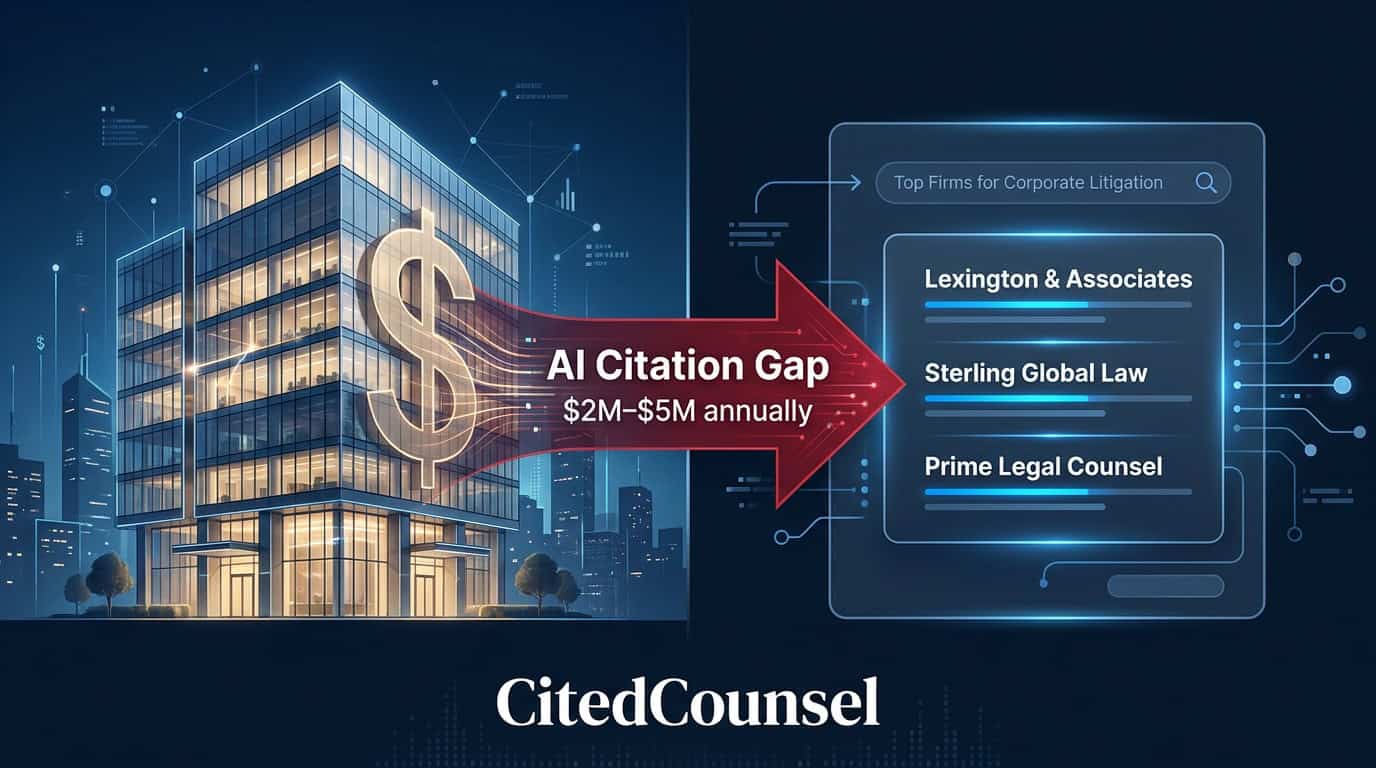
The dollar value of a law firm’s AI citation gap equals the sum of the estimated case values across all queries in which the firm is absent from AI search and a competitor is cited instead.
The law firm AI citation gap is the total case value lost when competitors appear in AI search answers for your practice area, and your firm does not. CitedCounsel, an AI citation audit and LLMSEO agency for US law firms, developed this formula to give managing partners a business-level number — case value at risk, not impressions or clicks — across any practice area and market. This article explains the four variables in the formula, how to apply it, and a worked example using published employment law matter value data from New York City. For a practical introduction to AI citation optimization, see how AI search engines decide which law firms to cite.
Last updated: May 2026
Table of Contents
Why Is Dollar Value the Right Metric for AI Citation Gaps?
Dollar value is the right metric because it translates AI search visibility into the only language a managing partner uses to evaluate investments: case value at risk. Impressions, citation counts, and domain authority are useful for tracking progress, but they do not answer the question a managing partner actually asks — is this worth money, and how much?
Citation frequency without a dollar value attached is a marketing metric. A citation gap with a dollar value attached is a business metric.
When a general counsel types “employment attorney wrongful termination NYC” into Perplexity and gets a response citing three firms, the economic event that follows is not a page view. It is a potential matter worth $85,000–$180,000 at a plaintiff-side employment firm. The firm that appears in the answer is in the conversation. The firm that does not appear has forfeited its chance to receive that inquiry.
Pew Research Center data shows that when an AI-generated summary is displayed, only 8 percent of users click a standard search result below it. The firm that does not appear in the AI answer is not losing a click; it is forfeiting the conversation entirely, regardless of its Google ranking.
The traffic quality further compounds the value. A 2025 Semrush study found that visitors arriving through AI citations convert at roughly 4.4 times the rate of visitors from standard organic search. For legal matters, where a single converted inquiry can be worth six or seven figures, that conversion premium transforms the AI citation question from a marketing discussion into a financial one.
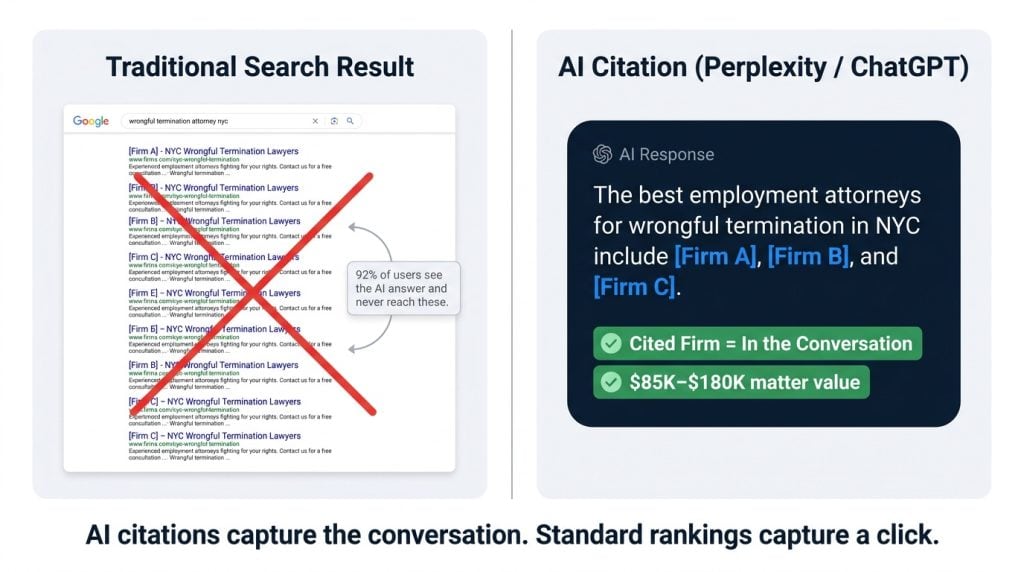
Citation rate determines the fraction of those conversations in which a firm participates. A firm cited in 15 of 20 tested queries has a 75% citation rate. A firm cited in zero has a 0% citation rate. The gap between the two numbers, multiplied by the estimated matter value per query, yields the addressable case value the firm is not capturing.
Citation rate — how often a firm appears in AI answers for high-value queries in its market — is the foundational metric for calculating AI citation gap value.
This number is an estimate, not a guarantee. It represents addressable case value: the revenue that flows to whoever appears in those answers, not a projection of what any specific firm would close. Its purpose is to give managing partners a rational basis for deciding whether to invest in AI citations and how much to invest.
The Four Variables in the AI Citation Gap Formula
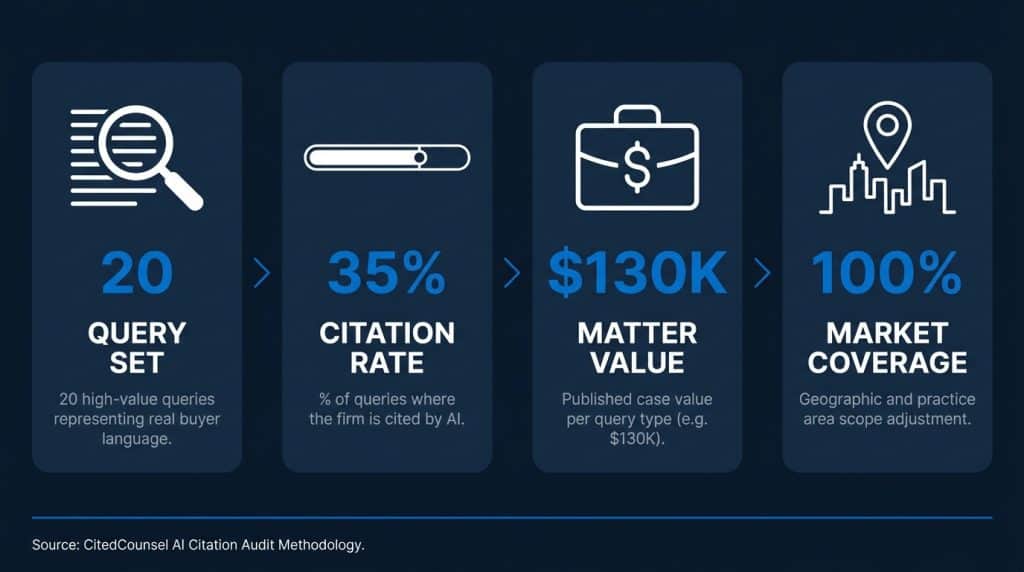
The formula has four inputs: the query set, the citation rate, the matter value per query type, and the market coverage.
Variable 1: Query set. A citation audit tests a specific set of queries (typically 20) that represent the highest-value searches a potential client would type into ChatGPT, Perplexity, or Google AI Overviews when seeking outside counsel in a firm’s practice area and geography. Query selection is not arbitrary. CitedCounsel selects queries based on three criteria: they represent a distinct matter type, they reflect language a GC or plaintiff would actually use (not attorney jargon), and they have a clear case value associated with the matter type they describe.
For an employment law firm in New York City, the query set would include terms such as “employment attorney wrongful termination NYC,” “discrimination lawyer New York City,” “FMLA violation attorney NYC,” and “employment contract dispute lawyer New York.” Each query maps to a distinct matter type with a distinct case value range.
Variable 2: Citation rate. For each query in the set, CitedCounsel tests the firm’s visibility across all three major AI engines: ChatGPT (GPT-4o with browsing), Perplexity, and Google AI Overviews. A query is considered cited if the firm is mentioned in the AI engine’s response. Citation rate is the percentage of queries across which the firm is cited.
A firm cited in 4 of 20 queries has a 20% citation rate. The 16 queries where it was absent represent the citation gap: the portion of addressable case value currently flowing to competitors.
Variable 3: Matter value per query type. Each query type maps to an estimated case value range drawn from published legal industry data, including Bureau of Justice Statistics civil trial outcome surveys, EEOC charge and settlement disclosures, and law firm benchmarking publications. CitedCounsel uses conservative midpoint estimates:
| Matter type | Value range | Midpoint used |
|---|---|---|
| Wrongful termination | $85,000–$180,000 | $130,000 |
| Discrimination and harassment | $150,000–$450,000 | $300,000 |
| Wage and hour collective action | $250,000–$1,000,000+ | $400,000 |
| Employment contract dispute | $75,000–$200,000 | $135,000 |
| FMLA / leave violation | $60,000–$150,000 | $100,000 |
For commercial litigation, IP, and M&A practices, the ranges differ substantially. M&A matters typically carry values an order of magnitude higher than employment matters.
Variable 4: Market coverage. AI citation audits test one firm against the query set, not an entire market. Market coverage adjusts the addressable case value estimate to reflect how many of the tested queries a firm could realistically compete for, given its geographic footprint and practice area scope. A New York City firm with a national employment law practice has broader market coverage than one that serves only the five boroughs.
The four variables in the AI citation gap formula are: the query set tested, the firm’s citation rate across those queries, the matter value assigned to each query type, and the firm’s realistic market coverage.
The Formula
The AI citation gap formula adds the estimated matter value for each query where the firm was absent. The sum across all 20 queries is the estimated annual addressable case value that the firm is not competing for.
AI Citation Gap Value = Sum of (Matter Value per Query × Gap Citation Rate) across all queries in the set
Where Gap Citation Rate for a given query = 1 minus the firm’s observed citation rate for that query (1 if the firm was not cited, 0 if it was).
In plain terms: for every query where the firm did not appear, add the estimated matter value for that query type to the gap total. The sum is the estimated annual addressable case value the firm is not participating in.
This is a gross figure, not a net figure. It does not account for close rates, conflicts, or whether every cited firm actually receives a matter from every citation. It represents the case value in play across those queries: the pool the firm is not competing for because it is absent from the answer.
How Do AI Engines Decide Which Law Firms to Cite?
AI engines decide which law firms to cite based on three factors: brand entity strength, direct-answer content structure, and FAQ schema markup. They do not rank firms by Google authority, firm size, or years in practice.
The citation decision is made at the passage level, not the page level. A 2025 study found that an 885-word page was cited over a 3,051-word competitor page. Despite the longer page having seven schema types and 624 verified reviews, the shorter page was cited because it contained a unique, quotable answer in its first two paragraphs. Longer is not better. Direct is better.
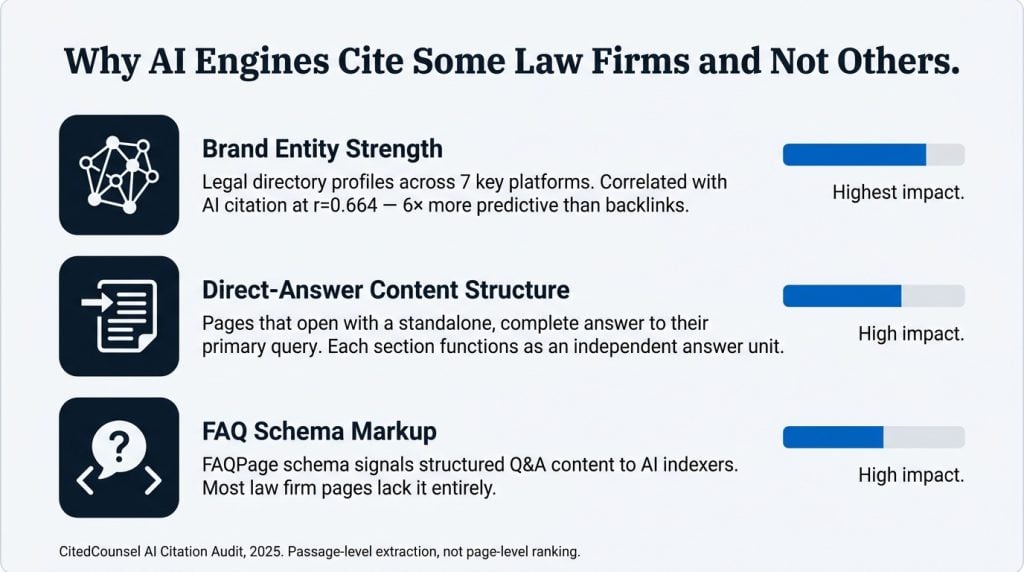
The three factors in detail:
- Brand entity strength. Ahrefs research published in December 2025 found that brand mentions across the web correlate with AI citation rates at r=0.664, compared to backlinks at r=0.218 — a significantly weaker predictor. For law firms, the primary brand-entity source layer comprises the seven major legal directories: Martindale-Hubbell, Avvo, Justia, Super Lawyers, Best Lawyers, Chambers, and Legal 500. Incomplete or inconsistent profiles across these directories suppress citation rates regardless of content quality.
- Direct-answer content structure. Practice area pages that open with a complete, self-contained answer to their primary query are extracted and cited at higher rates than pages that build gradually to a conclusion. Each H2 section should function as an independent answer unit, not a continuation of the argument above it.
- FAQ schema markup. The FAQPage schema tells AI engines that a page contains structured question-and-answer content. Pages with validated FAQPage schema are indexed and extracted differently from unstructured narrative pages. This matters most for high-intent queries that precede legal-matter inquiries.
The firms that appear in AI-generated answers to legal queries are not always the largest or most decorated. They are the firms whose content is structured for AI extraction. A 22-attorney NYC employment firm with a structured content approach can displace a 150-attorney firm with no direct-answer architecture. The content gap is the competitive gap.
A Worked Example: NYC Employment Law Firm
CitedCounsel recently audited an employment law firm operating in New York City. The full NYC employment law AI citation audit covers the complete methodology and results. The firm has 18 attorneys and has been in practice for 11 years. It has solid Google rankings for several employment law terms, but has never tested its AI citation profile.
The audit tested 20 queries across ChatGPT, Perplexity, and Google AI Overviews. The firm appeared in 3 of 20 queries (15% citation rate). Across the 17 queries where it was absent, the gap calculation looked like this:
| Query type | Queries in gap | Midpoint matter value | Gap value |
|---|---|---|---|
| Wrongful termination | 5 | $130,000 | $650,000 |
| Discrimination / harassment | 4 | $300,000 | $1,200,000 |
| Wage and hour | 2 | $400,000 | $800,000 |
| Employment contract | 3 | $135,000 | $405,000 |
| FMLA / leave | 3 | $100,000 | $300,000 |
| Total | 17 | $3,355,000 |
Estimated annual AI citation gap value: $3.35M. (Based on published industry average matter values. Not representative of any specific firm’s actual revenue situation.)
This is not $3.35M in lost revenue. The firm is not closing every matter that flows from every AI citation. It is $3.35M in addressable case value that flows through AI-search-generated inquiries in this market, none of which the firm is currently competing for, because it does not appear in those answers.
The competitor that appeared in 16 of 20 queries in the same audit has an estimated 80% citation rate. That firm is participating in most of that case value flow. It has 22 attorneys. It is not the largest or the most decorated firm in NYC employment law. Its content is structured for AI citation.
A law firm with a 15% AI citation rate across 20 high-value employment law queries is forfeiting an estimated $3.35M in addressable case value annually to the competitors that do appear in those answers.
Understanding the Three Gap Tiers
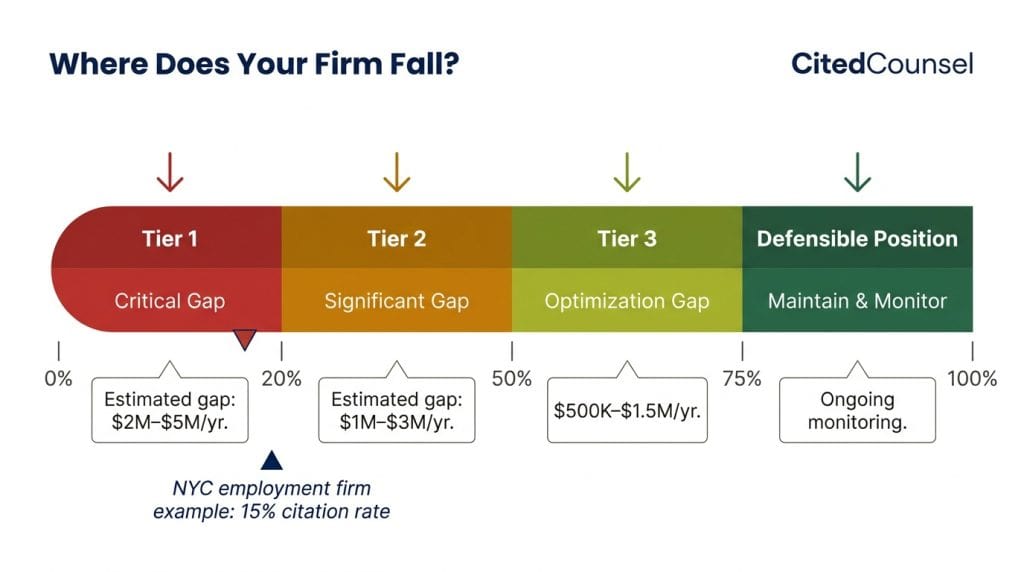
CitedCounsel’s audits consistently produce three distinct gap tiers. The tier a firm falls into determines the urgency and scope of the remediation work required.
| Tier | Citation rate | Estimated annual gap value (employment law, major US market) | Typical root cause |
|---|---|---|---|
| Tier 1 — Critical gap | 0–20% | $2M–$5M | No legal directory profiles; no direct-answer pages; no FAQ schema |
| Tier 2 — Significant gap | 20–50% | $1M–$3M | Partial directory coverage; inconsistent direct-answer structure |
| Tier 3 — Optimization gap | 50–75% | $500K–$1.5M | Gaps in specific query types or practice sub-areas |
| Defensible position | 75%+ | Maintenance mode | Ongoing monitoring as AI engine landscape evolves |
Tier 1: Critical gap (0–20% citation rate): The firm is structurally invisible. It appears in fewer than 4 of 20 tested queries. This is typically explained by one or more of the following: no profiles on the seven key legal directories (Chambers, Legal 500, Super Lawyers, Best Lawyers, Martindale-Hubbell, Avvo, Justia), practice area pages with no direct-answer structure, and no FAQ schema markup. Estimated gap value for a mid-size employment law firm in a major US market: $2M–$5M annually.
Tier 2: Significant gap (20–50% citation rate): The firm appears in some queries but is absent from the majority. It typically has partial directory coverage and some direct-answer content, but has not structured its high-value pages consistently. Estimated gap value: $1M–$3M annually.
Tier 3: Optimization gap (50–75% citation rate): The firm appears in most queries but is missing from a meaningful subset. It has solid entity authority and some AI-optimized content, but has gaps in specific query types or practice sub-areas. Estimated gap value: $500K–$1.5M annually.
Firms above 75% citation rate have achieved a defensible position. The work at that point shifts from remediation to maintenance and monitoring as the AI engine landscape evolves.
What to Do With the Number
The citation gap dollar value answers one question: Is it worth investing in AI citation optimization? For most mid-size law firms, the answer is straightforward. A $3M gap value justifies a $5,000–$15,000 investment in remediation work with considerable margin.
The next three steps produce the fastest return on that calculation.
First, run a formal audit. The $197 AI Citation Report from CitedCounsel tests a firm across 20 queries, identifies the exact citation gap, maps which competitors are capturing each query, and produces a prioritized action plan. Get your AI Citation Report here, the fastest way to convert the generic formula into firm-specific numbers.
Second, fix entity authority before touching content. Ahrefs research shows brand mentions correlate with AI citation rates at r=0.664, three times more predictive than backlinks (r=0.218). The seven legal directories (Martindale-Hubbell, Avvo, Justia, Super Lawyers, Best Lawyers, Chambers, Legal 500) are the primary brand entity source layer for law firms. Complete, consistent profiles across these directories produce citation improvements within 2–4 weeks, faster than any content work.
Third, restructure the two or three highest-value practice area pages for direct-answer architecture. See how AI search engines decide which law firms to cite for the full breakdown. A page that opens with a direct, complete answer to its primary query, followed by FAQ schema targeting the exact questions potential clients type into ChatGPT, is the content format AI engines extract and cite. Most law firm practice area pages are not structured this way.
Frequently Asked Questions
Q: Is the AI citation gap dollar value a guaranteed revenue figure?
A: No. It is an estimate of addressable case value in play: the matter value that flows through AI-search-generated inquiries in a given market across the tested queries. Close rates, conflicts, and competitive win rates are not included. Its purpose is to provide managing partners with a rational basis for evaluating AI citation investments, not to project actual revenue recovery.
Q: How often does the citation gap change?
A: AI citation patterns shift as models are updated, new content is indexed, and competitor profiles change. CitedCounsel recommends re-testing quarterly. A firm that completes remediation work and retests at 90 days typically shows meaningful improvement in citation rate, with further improvement at 180 days as new content accumulates authority.
Q: Does a higher Google ranking reduce the citation gap?
A: Not directly. Google search rankings and AI citation rates are correlated but not equivalent. A firm can rank number one in Google for “wrongful termination attorney NYC” and have a zero citation rate in Perplexity. The two systems use different signals. Google rankings do not substitute for the entity authority and direct-answer content structure that AI engines require.
Q: What practice areas have the highest citation gap values?
A: M&A and commercial litigation practices typically produce the highest gap values because matter values are substantially larger than employment law. A commercial litigation firm with a $500,000–$2M average matter value and a 10% citation rate across 20 queries has a gap value that dwarfs the employment law example in this article. Employment law is used here because it is CitedCounsel’s launch practice area and the data is most complete.
Q: Can a firm calculate its own citation gap without an audit?
A: Yes, with significant effort. The firm needs to select 20 representative queries, test each one across ChatGPT, Perplexity, and Google AI Overviews (noting whether the firm is cited in each), assign matter values to each query type using published data, and apply the formula. The manual process takes 4–6 hours and requires access to all three AI engines with browsing enabled. The $197 AI Citation Report delivers the same output in 15 minutes and includes competitor identification and prioritized remediation steps that the manual process does not produce.
Q: How does the formula handle firms with multiple practice areas?
A: The audit is structured by practice area. A firm with employment law and commercial litigation practices would run separate 20-query sets for each, producing separate gap values. The combined gap value is the sum across all practice areas tested. CitedCounsel’s $197 report covers one practice area; multi-practice audits are priced separately.
Q: What is the typical citation gap for a mid-size law firm that has never optimized for AI search?
A: Based on CitedCounsel’s audits, a mid-size firm with no prior AI citation work typically falls in Tier 1 (0–20% citation rate), producing an estimated gap value of $2M–$5M for employment law practices and $5M–$15M for commercial litigation practices in major US markets. These figures are based on published industry-average market values, not any specific firm’s actual financials.
Q: Does the formula apply to firms in markets outside the United States?
A: Yes, with adjusted matter values. CitedCounsel has audited employment law practices in Australia and commercial law practices in Canada using the same methodology with locally sourced matter value data. The citation rate component is identical; the matter values differ by jurisdiction and practice area.
About the Author
Vinay Koshy is the founder of CitedCounsel, an AI citation and LLMSEO agency for US law firms. CitedCounsel audits law firms across ChatGPT, Perplexity, and Google AI Overviews, identifies citation gaps by practice area, and implements the entity authority and direct-answer content changes that improve citation rates. Vinay writes on AI search behavior, citation optimization methodology, and the business case for LLMSEO in legal marketing.
This article is for informational purposes only and does not constitute legal or financial advice. Matter value estimates are based on published industry data and are illustrative only; they are not representative of any specific firm’s actual revenue situation. Reading this article does not create an attorney-client relationship. Consult a qualified attorney and financial advisor for advice specific to your situation.